
Scatec Tightens African Renewable Footprint as Egypt’s Obelisk Draws in National Bank of Egypt
From the deserts of Egypt to the mining belts of Botswana and the wind corridors of Tunisia, Scatec ASA is rapidly assembling one of Africa’s most consequential renewable energy footprints. Its latest move, bringing the National Bank of Egypt into the ownership structure of the 1.1GW Obelisk solar-and-storage megaproject, signals more than another financing deal. It marks the tightening convergence of capital, energy security and industrial policy around a new generation of African power infrastructure, where hybrid renewables are no longer experimental assets at the edge of the grid, but strategic engines at the centre of it.
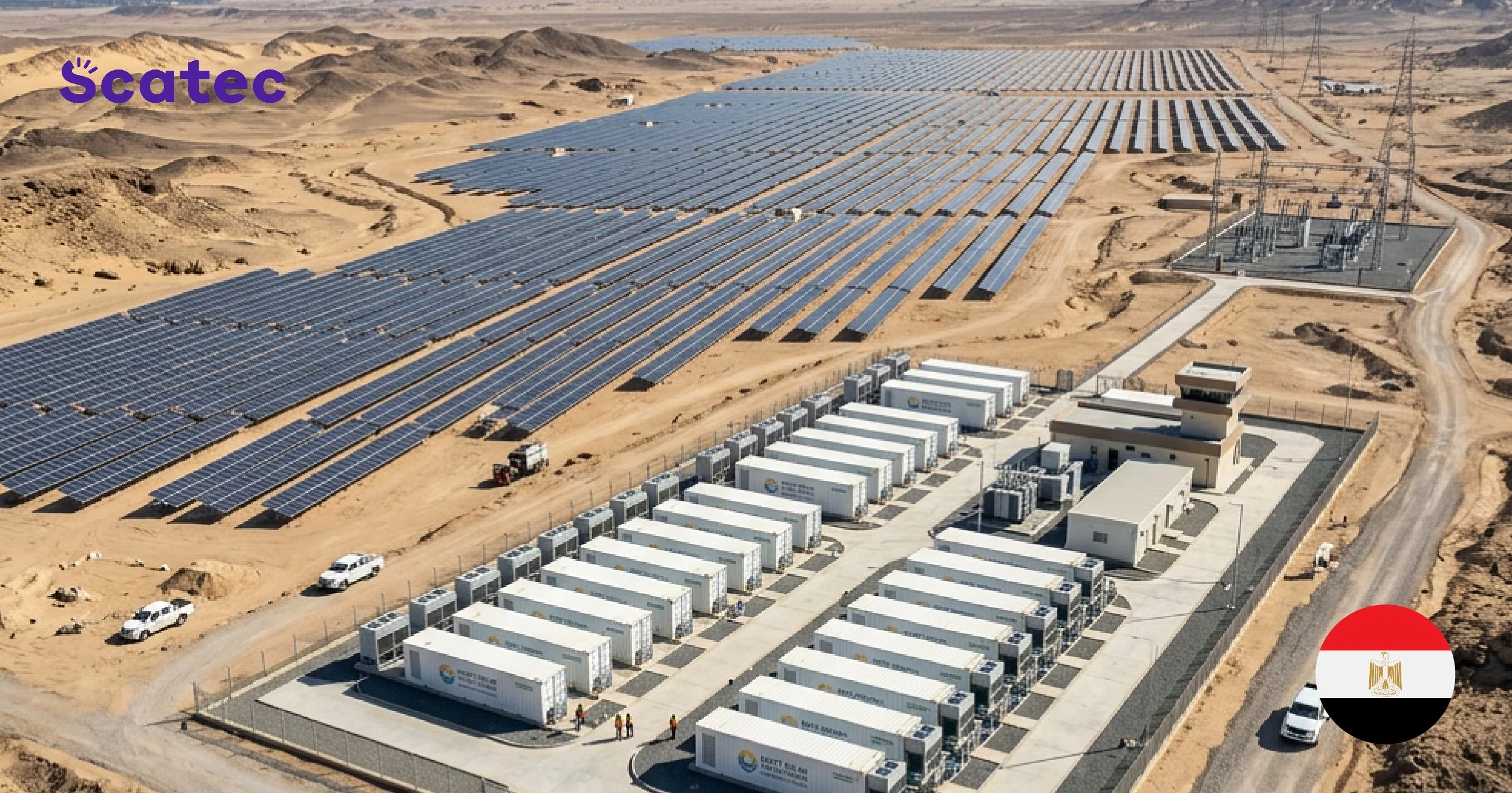
Cairo, Egypt | May 8, 2026 - In a transaction that underscores the increasingly institutional character of Africa’s renewable energy buildout, Scatec ASA has signed a shareholder agreement with the National Bank of Egypt for an equity partnership in the 1.1GW Obelisk solar and battery storage project in Egypt, bringing the country’s largest commercial bank directly into one of the continent’s most consequential clean energy developments.
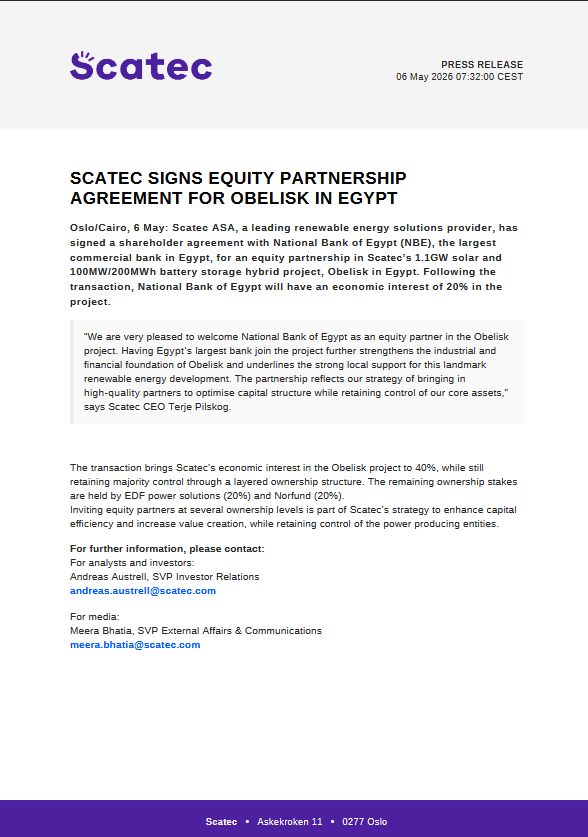
The agreement, announced from Oslo and Cairo on May 6, grants the National Bank of Egypt a 20% economic interest in the project. Following the transaction, Scatec’s economic interest falls to 40%, though the Norwegian renewables developer retains majority control through a layered ownership structure. The remaining stakes are held by EDF power solutions and Norfund, each with 20%.
“We are very pleased to welcome National Bank of Egypt as an equity partner in the Obelisk project,” said Scatec Chief Executive Officer Terje Pilskog. “Having Egypt’s largest bank join the project further strengthens the industrial and financial foundation of Obelisk and underlines the strong local support for this landmark renewable energy development.”
The deal represents more than a financing adjustment. It is the latest signal that large-scale African renewable infrastructure is entering a phase where domestic financial institutions are beginning to anchor projects once largely dependent on development finance institutions and foreign capital.
Obelisk’s Continental Significance
Obelisk has rapidly emerged as one of the defining utility-scale renewable projects on the African continent. The hybrid facility combines 1.1GW of solar generation capacity with a 100MW/200MWh battery energy storage system, positioning it among the largest integrated solar-and-storage complexes under development globally.
When fully completed, the project is expected to generate more than 3,000GWh of electricity annually while abating over 1.2 million tonnes of CO₂-equivalent emissions each year. Earlier this year, the project reached commercial operations date for its first phase, marking a critical operational milestone for Egypt’s broader energy transition ambitions.
The project also serves as a strategic litmus test for Cairo’s renewable energy agenda as the country seeks to expand non-hydro renewable penetration and reinforce grid resilience amid rising electricity demand and persistent regional supply pressures.
For Scatec, Obelisk represents the culmination of a business model the company has spent years refining across emerging markets: originate large-scale renewable projects, structure long-term contracted revenues, introduce institutional and strategic equity partners, and retain operational control over core assets.
The company said inviting equity partners at multiple ownership levels forms part of its strategy to improve capital efficiency and increase value creation while maintaining control of power-producing entities.

From Egypt to Tunisia to: A Rapid-Fire North African Expansion
The Egypt transaction lands against the backdrop of one of Scatec’s busiest African expansion cycles in recent years, stretching from North Africa’s solar and wind corridors to Southern Africa’s mining-energy nexus.
The chronology reveals a company steadily broadening both its geographic footprint and technology mix.
In January, Scatec secured a 25-year power purchase agreement with Tunisia’s state utility, Société Tunisienne de l'Electricité et du Gaz, for the 75MW El Fahs onshore wind project. The development marked the company’s first wind power project in Tunisia and a notable extension beyond its established solar portfolio.
“The El Fahs wind project is a strategic milestone as we expand our presence in Tunisia and partnership with Aeolus, while broadening our technology footprint,” Pilskog said at the time.
The Tunisian award signaled an important shift in Scatec’s North African positioning. Rather than approaching the region through isolated assets, the company began assembling what increasingly resembles a multi-technology regional platform.
The Tunisian story accelerated further in April when Scatec and partner Aeolus SAS achieved commercial operations date for the 60MW Tozeur solar plant, shortly after the Sidi Bouzid 60MW facility also entered operation.
Together, these projects are expected to produce approximately 288GWh of electricity annually and offset more than 115,000 tonnes of carbon emissions each year.
More importantly for Scatec, the developments established its first operational assets in Tunisia, effectively converting earlier procurement wins into producing infrastructure.
“With Tozeur now in operation alongside Sidi Bouzid, we are establishing a solid platform for growth in Tunisia,” Pilskog said. “With three additional projects already in our backlog, we are well positioned to continue scaling our presence and supporting the country’s transition to renewable energy.”
South Africa and Botswana Extend the Southern Push
Further south, Scatec has also been tightening its presence across mining-linked and private-sector-backed renewable developments.
In March, Lyra Energy, Scatec’s South African joint venture, reached financial close for the 255 MW Thakadu solar power plant. Backed by private-sector offtake agreements and financed through a combination of project debt and sponsor equity, the project underscores the growing role of private procurement in South Africa’s evolving electricity market.
Construction of the project’s first phase has already commenced, with commercial operations expected in the first half of 2027.
“This marks an important milestone for Lyra Energy and the Thakadu project,” Pilskog said following financial close.
Just weeks earlier, Release, a Scatec-linked platform, signed a seven-year lease agreement with Tshukudu Metals Botswana for a 21 MW solar plant at the Motheo copper mine near Ghanzi.
The arrangement reflects a broader trend increasingly visible across African mining corridors: renewable energy being deployed not only as a climate instrument, but as a hedge against volatile grid supply and rising energy costs.
“This agreement demonstrates the strength of our lease-to-own solution, where we combine technical expertise with flexible financing to enable our clients to access large-scale solar without upfront capital investment,” said Hans Olav Kvalvaag.
Once operational, the Botswana facility is expected to cover approximately 30% of Motheo’s annual electricity demand.

The Emerging Shape of Africa’s Energy Transition
Viewed collectively, the projects illuminate broader structural changes underway across African energy markets.
The continent’s renewable expansion is no longer confined to donor-backed pilot projects or isolated utility procurements. Increasingly, it is becoming an interconnected investment ecosystem involving sovereign utilities, commercial banks, mining operators, private offtakers and layered international capital.
Scatec’s evolving portfolio also demonstrates how developers are repositioning themselves from pure asset builders into integrated infrastructure operators spanning engineering, procurement, construction, operations, maintenance and asset management.
The strategy appears calibrated for a continent where energy deficits remain acute, financing conditions remain uneven, and governments continue searching for scalable pathways to industrialisation without replicating carbon-intensive growth models.
Against that backdrop, Obelisk is more than a single Egyptian megaproject. It is increasingly emerging as a symbol of where Africa’s energy transition is heading: utility-scale, hybridised, financially syndicated, and progressively domesticated through local institutional participation.
