Greater Tortue Ahmeyim Turns the Senegal-Mauritania Border Into West Africa’s New LNG Front Door
Greater Tortue Ahmeyim has finally crossed from ambition to production, turning a deepwater gas discovery on the Mauritania-Senegal maritime border into West Africa’s newest LNG export platform. After years of diplomacy, engineering delays and commissioning risk, the BP-operated project is now testing whether a shared offshore field can become not just a cargo story, but a durable industrial anchor for two states entering the global LNG trade together.
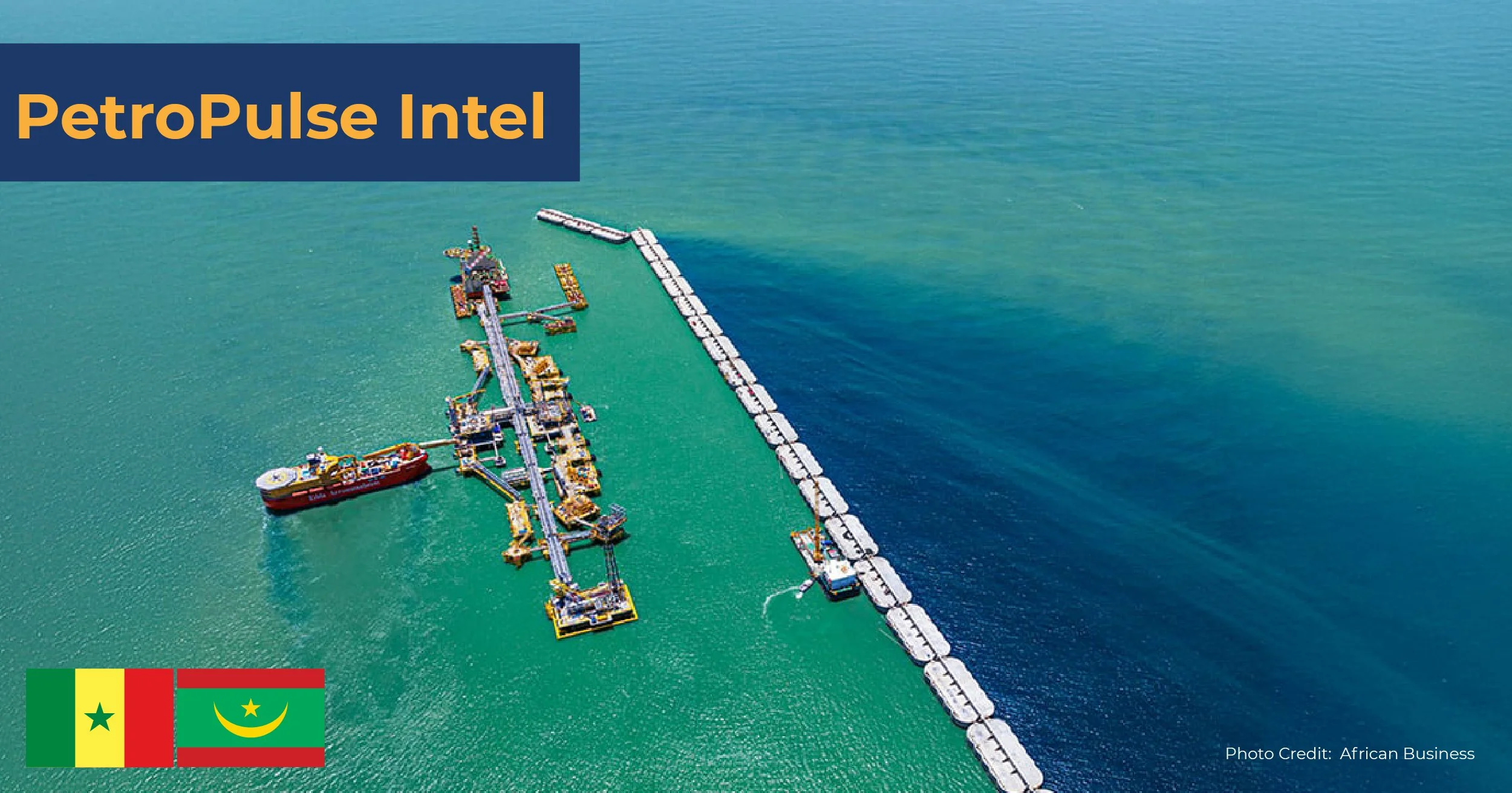
Mauritania/Senegal, West Africa | June 5, 2026 - Greater Tortue Ahmeyim has moved from frontier promise to operating LNG province, giving Mauritania and Senegal their first major foothold in the global LNG trade after nearly a decade of discovery, cross-border diplomacy, engineering risk and delayed execution. The BP-operated project, which straddles the maritime border of both countries, achieved first gas on December 31, 2024, produced first LNG in February 2025 and exported its first gross LNG cargo in April 2025, turning one of West Africa’s most closely watched offshore gas developments into a live production system.
A Border Field Built for Two States
GTA’s significance lies not only in its scale, but in its geography. The field sits across Mauritania’s Block C8 and Senegal’s Saint-Louis Offshore Profond Block, roughly 120 kilometres offshore and in water depths reaching about 2,700 to 2,800 metres, making it one of Africa’s more technically demanding deepwater gas developments.
Phase 1 is built around a deepwater subsea system feeding gas to a Floating Production Storage And Offloading (FPSO) vessel, which processes the gas before sending it by pipeline to a floating LNG facility positioned behind a nearshore hub on the maritime border. GTA Phase 1 was designed to produce around 2.3 million tonnes of LNG a year, using an FLNG vessel with nameplate capacity of about 2.7 mtpa; the project is also planned to make gas available for domestic use in Mauritania and Senegal.
That architecture is what makes GTA more than another offshore development. It is a border project, a floating LNG project and a state-building energy project at once, designed to monetise a shared resource while giving both governments a stake in the birth of a new Atlantic gas province.
Ownership and the Political Bargain
The project is operated by BP, with Kosmos Energy and the national oil companies of both countries, PETROSEN and Société Mauritanienne des Hydrocarbures (SMH), as partners. BP’s first-gas announcement identified the Phase 1 equity split as BP 56%, Kosmos 27%, PETROSEN 10% and SMH 7%.
Kosmos’ 2025 annual filing gives the company’s more precise interest in the GTA unit as 26.8% in Mauritania and 26.7% in Senegal, subject to redetermination under the unitisation arrangements. The same filing records that Mauritania and Senegal issued exploitation authorisations in February 2019, giving the partnership the right to develop and produce gas for an initial period running to 2044 in Senegal and 2049 in Mauritania.
The legal settlement came before the engineering prize. Mauritania and Senegal signed an Inter-State Cooperation Agreement in February 2018 to unitise the field, followed by the approval of the GTA Unitisation and Unit Operating Agreement in February 2019. In practical terms, that transformed a cross-border reservoir from a potential diplomatic fault line into a jointly governed LNG development.
The Discovery That Recast the Basin
The GTA story began with Kosmos’ basin-opening exploration campaign. The Tortue-1 well in Mauritania was discovered in May 2015, followed by Guembeul-1 in Senegal in January 2016. Kosmos’ annual filing describes GTA as one of the largest natural-gas discoveries worldwide in 2015 and one of the largest gas discoveries ever offshore West Africa. (SEC)
Further appraisal tied the geology together. Kosmos says the Tortue-1, Guembeul-1, Ahmeyim-2 and Greater Tortue Ahmeyim-1 wells delineated the Ahmeyim and Guembeul discoveries and demonstrated reservoir continuity, including pressure communication across the Lower Cenomanian reservoir. (SEC)
By December 2018, the partners had reached final investment decision for Phase 1. The following year brought the exploitation authorisations and unit operating framework; in February 2020, BP Gas Marketing was selected as the buyer for the Phase 1 LNG offtake under a sale and purchase agreement running initially to the end of 2033, with an option to extend by ten years. (SEC)
The Long Road From FID to First Cargo
GTA did not reach market on the timeline once targeted. Kosmos’ earlier project materials pointed to first gas in the first half of 2022; actual first gas came only on December 31, 2024, with first LNG in February 2025 and the first gross LNG cargo exported in April 2025.
That delay matters because GTA’s economics are not theoretical. It is a large, capital-intensive, floating LNG system whose value depends on sustained uptime, cargo regularity and the conversion of proved undeveloped volumes into proved developed reserves. Kosmos reported first gas production from the subsea system on December 31, 2024, first LNG in February 2025 and 18.5 gross LNG cargoes lifted in 2025 as the project ramped up.
By mid-2025, the project had crossed another commercial threshold. Kosmos confirmed in June 2025 that Golar’s FLNG Gimi had reached commercial operations date under its 20-year lease-and-operate agreement with BP. The milestone followed first LNG in February and first cargo in April, with subsequent cargoes loaded in May and early June.
The Challenges Beneath the Breakthrough
The first challenge has been execution. GTA is deepwater, cross-border and floating LNG, a combination that leaves little room for weak coordination. The project’s own delivery history shows that the passage from FID to production was longer than originally expected, with the first-gas target slipping from the first half of 2022 to the final day of 2024.
The second challenge is environmental and social licence. A 2026 study of fishing communities around Saint-Louis reported fishermen’s concerns over access restrictions, perceived income losses and environmental disruption linked to project activity, placing those concerns in a coastal zone already under pressure from erosion and other environmental stresses.
The third challenge surfaced during commissioning. Reuters reported in March 2025 that a gas leak had been detected at the GTA A02 well during planned commissioning tests, with BP saying the expected environmental impact was negligible and that production activities would not be disrupted. Mauritania’s environment ministry said it was investigating in coordination with relevant ministries and Senegalese authorities.
Recent Developments: From Start-Up to Ramp-Up
The latest signal is that GTA has moved beyond symbolic firsts into operating performance. Kosmos reported that GTA Phase 1 averaged about 17,000 barrels of oil equivalent per day net to the company in the first quarter of 2026, equal to about 2.85 mtpa of LNG equivalent gross, above the FLNG’s 2.7 mtpa nameplate capacity. The partnership lifted 9.5 gross LNG cargoes in the quarter and maintained full-year 2026 guidance of 32 to 36 gross LNG cargoes.
The domestic-gas dimension is also moving closer to execution. Kosmos said the partnership is now focused on Phase 1+, which would use existing infrastructure to support sales into domestic markets in Senegal and Mauritania, with heads of terms for domestic gas sales expected in 2026. Senegal has also begun construction of an onshore power plant near Saint-Louis and is expected to start construction of a pipeline network to move gas from the GTA hub terminal to shore for domestic power generation.
That is the pivot point for GTA. Its first act was to prove that Mauritania and Senegal could jointly commercialise a deepwater border field and enter the LNG-export club. Its second act will be judged by something harder: whether the project can sustain exports, reduce operating costs, manage social and environmental risk and convert offshore gas into domestic energy security on both sides of the border.
For now, GTA has crossed the line that separates ambition from production. The deeper test is whether the basin it opened can become not just a new LNG address, but a durable industrial platform for two states that chose cooperation before cargoes.
