
Rovuma Rising: ExxonMobil’s Mozambique LNG Project Moves Back Toward FID
Rovuma LNG is back in the investment window. With ExxonMobil and its Area 4 partners targeting a Q3 2026 final investment decision, a redesigned 18 mtpa project on the table and a fresh study putting Mozambique’s potential GDP lift at $11 billion a year, the long-delayed gas giant is again testing whether Africa can turn world-scale reserves into bankable energy infrastructure.
Maputo, Mozambique | June 11, 2026 - ExxonMobil’s Rovuma LNG project has moved back into decision-stage territory, with the Area 4 partners now anticipating a final investment decision (FID) in the third quarter of 2026 and first LNG production in 2030, while a fresh macroeconomic study projects that the project could add around $11 billion annually to Mozambique’s GDP. For a country whose gas promise has spent years trapped between world-scale reserves, security risk and financing caution, Rovuma is no longer just a deferred mega-project. It is becoming a major project-finance test for African energy.
While contractor selection remains a closely watched milestone for the market, the most firmly documented developments are the project’s progress toward FID, ongoing engineering and procurement preparation, and the broader economic case being built around Rovuma LNG. The stronger story is already substantial: the Area 4 partners have put Rovuma back into a visible FID window, ExxonMobil’s own expressions-of-interest portal shows a widening trail of Mozambique Rovuma Venture-linked supplier activity, and the project has a new economic frame around what Mozambique stands to gain if it finally crosses from engineering into execution.
The Number Mozambique Cannot Ignore
An updated macroeconomic study gives Rovuma LNG its new headline: around $11 billion in annual GDP contribution once fully operational. The same study projects that the project could also create approximately 151,000 direct, indirect and induced jobs, generate about $4 billion in annual fiscal revenues, add around $9 billion annually to Mozambique’s balance of payments and lift average household income by 21%. It also projects that Mozambique’s sovereign wealth fund could build a real balance of up to $81 billion by 2056 under the study’s current-case scenario.
Those figures are projections, not banked outcomes. But they matter because they turn Rovuma from an oil-and-gas development into a national macroeconomic question. If the project lands, it could reshape the state’s fiscal base, balance-of-payments position, local-content economy and long-term savings architecture. If it slips again, the gap between Mozambique’s discovered gas wealth and its realised development dividend will widen further.
The study is also notable for its timing. It focuses on an expanded Rovuma LNG capacity of 18 million tonnes per annum, up from the earlier 15.2 mtpa case, and uses updated project data. That matters because the project being assessed is not the original pre-disruption concept but the redesigned, modular version now being prepared for an FID window in 2026.
From FEED to FID
The path back to the decision window began formally in 2024, when the Area 4 concessionaires entered the front-end engineering design (FEED) phase for Rovuma LNG. At the time, Mozambique Rovuma Venture had awarded and executed FEED contracts to compete for the engineering, procurement and construction of the project, with that phase expected to take around 16 months and described as the last step before FID.
That 2024 step also recast the project’s technical design. The updated concept would use 12 electric-driven LNG modules of 1.5 mtpa each, giving the project total capacity of 18 mtpa. The modular concept was framed as a way to increase competitiveness and flexibility while reducing on-site presence, execution risk and emissions compared with the earlier development model.
The contractor trail reinforces that design shift: the project’s FEED work was awarded to Technip Energies and JGC Corporation for the Rovuma LNG development at Palma on the Afungi peninsula. The same contractor release described the planned plant as an 18 mtpa facility comprising 12 fully modularised LNG trains of 1.5 mtpa each, putting technical detail behind the redesigned execution model.
The broader Area 4 contractor picture has also strengthened around Mozambique’s LNG build-out. In June 2026, Technip Energies, in partnership with JGC and Samsung Heavy Industries, secured an EPCIC contract from Mozambique Rovuma Venture for the Coral Norte floating LNG project, an offshore development led by Eni and its partners CNPC, ENH, XRG and KOGAS. Coral Norte is designed to produce about 3.6 mtpa of LNG, doubling the Coral hub’s capacity to 7 mtpa, and is framed as an enhanced replica of Coral Sul. It is not Rovuma LNG’s onshore EPC award, but it matters for the story: within the same Area 4 ecosystem, contractors are moving from engineering into awarded execution work, reinforcing the sense that Mozambique’s LNG portfolio is again advancing.
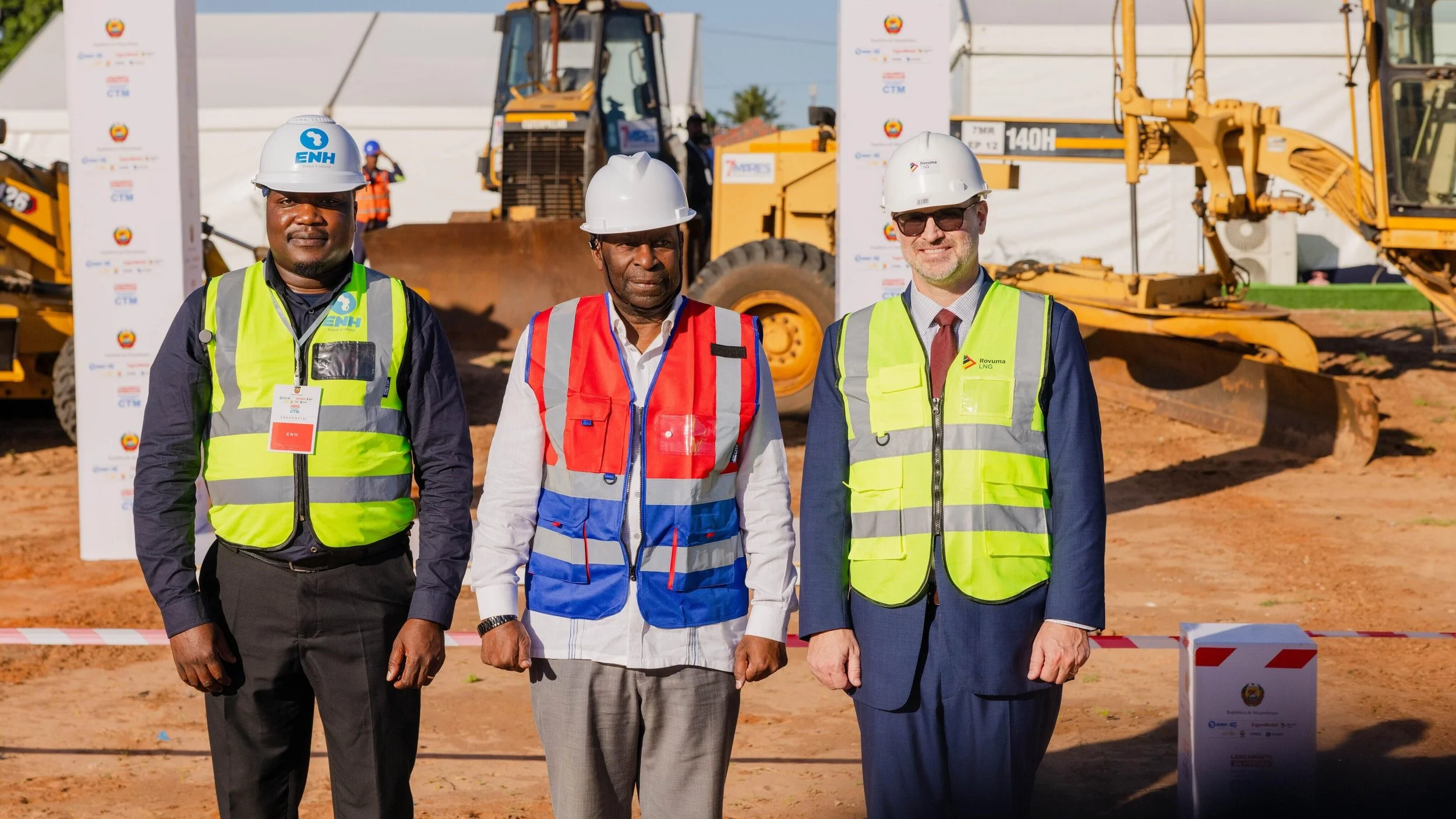
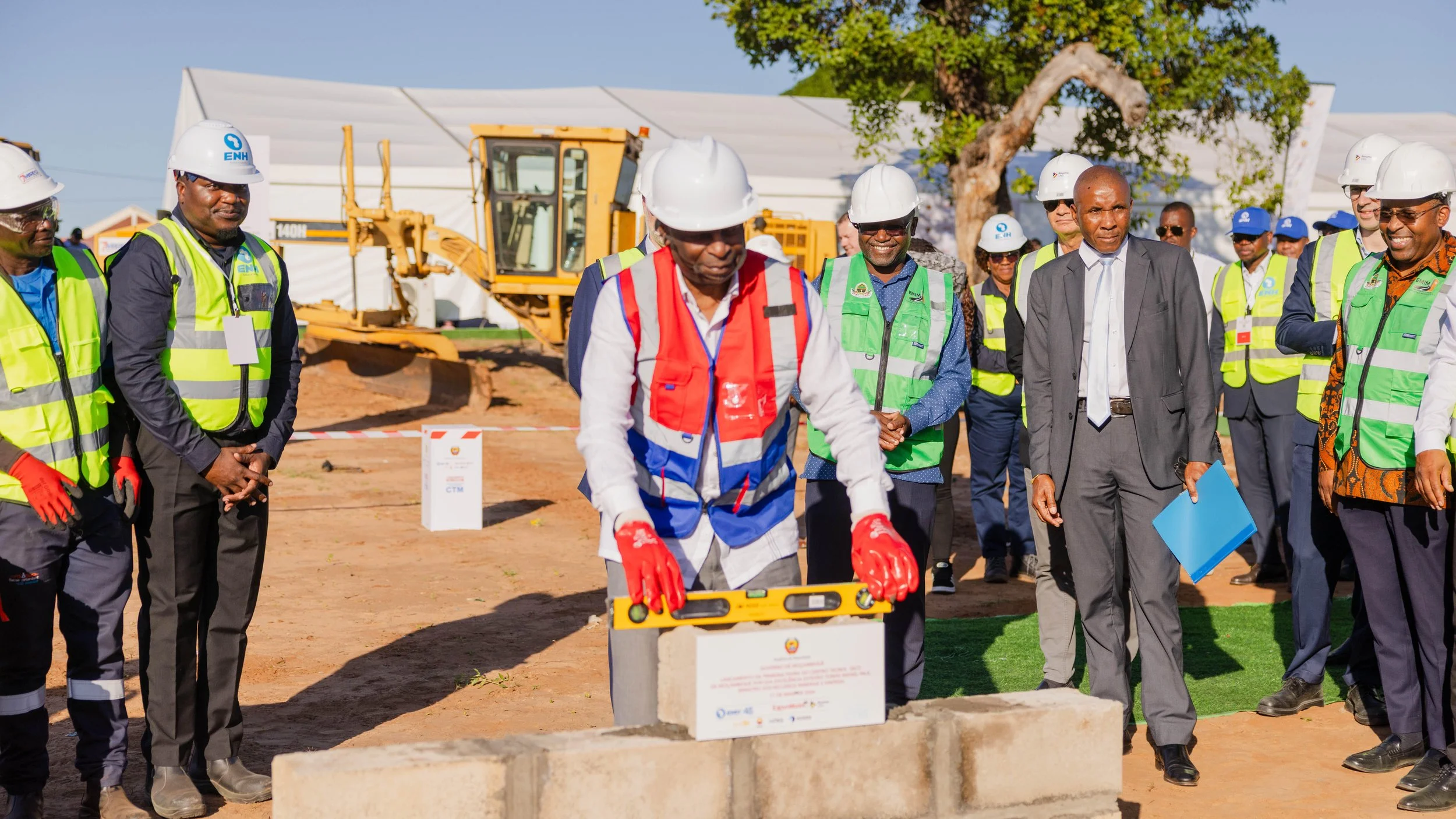
In May 2026, the project’s timetable became more concrete. At the groundbreaking of the Centro Tecnológico de Moçambique, a $40 million training facility funded by Rovuma LNG in partnership with ENH, the May 2026 project update said the updated Plan of Development for Rovuma LNG was advancing and that the Area 4 partners anticipated taking FID in the third quarter of 2026, with first LNG production targeted for 2030.
That sequence matters. Rovuma is not being revived by a single press statement. It is moving through a chain: redesigned FEED, contractor-level engineering, local-content infrastructure, a live procurement portal, an updated development plan and a publicly stated Q3 2026 FID target. In project-finance terms, this is the point where intention begins to face the discipline of contractors, lenders, fiscal terms, security costs and execution schedules.
Procurement Becomes the Quiet Signal
ExxonMobil’s expressions-of-interest portal does not prove that FID has been taken. It does something subtler but still important: it shows a widening supplier-readiness trail around the project.
The portal says qualified companies are being invited for goods and services and lists Mozambique Rovuma Venture-linked notices across coral and seagrass relocation, STEM training, English-language training, accommodation and transport, third-party inspection, fuel delivery, aviation services, offshore supply vessels, customs clearance, freight forwarding, recruitment support, drill pipe, workforce services, rig positioning, casing services, ROV equipment, shorebase logistics, cement services, drilling fluids, logging, wellhead equipment and a mobile offshore drilling unit.
For a project still short of FID, that supplier trail is important but must be read carefully. It is not the same as sanction. It is not an EPC award. It is not first cargo. But it is strong evidence that the project is being prepared operationally, with the kind of procurement and localisation work that typically precedes a serious execution push.
That is where the still-unconfirmed EPC story belongs. Contractor-focused and market-facing analysis has treated Rovuma’s EPC race as the next major signal, with one analytical take on Rovuma and reporting on the contractor selection process pointing to growing attention around the project. But absent a direct announcement from ExxonMobil, Mozambique Rovuma Venture, the Mozambican government or the contractors, the EPC point should remain a watch line rather than the story’s factual spine.
New Leadership for a Project Entering a Harder Phase
The timing of ExxonMobil Mozambique’s leadership change adds another layer to the project’s return to the decision window: Johanna Boothey in Maputo as Lead Country Manager and Chairperson of ExxonMobil Moçambique, effective June 1, giving the company a visible country head as Rovuma approaches one of its most consequential investment gates.
That appointment is not, on its own, proof of project sanction. But leadership matters at this stage of the cycle. A project moving toward FID in Cabo Delgado must align engineering, finance, local-content commitments, security assumptions, government expectations and contractor readiness. The appointment gives the project a visible country head at precisely the point where the discussion shifts from promise to execution.
The Structure Behind the Bet
Rovuma LNG sits in Mozambique’s Area 4, operated by Mozambique Rovuma Venture, a joint venture owned by ExxonMobil, Eni and China National Petroleum Corporation. MRV holds a 70% interest in the Area 4 Exploration and Production Concession Contract, while Galp, KOGAS and Mozambique’s state oil company ENH each hold 10%. ExxonMobil holds a 25% indirect interest in Area 4 and leads the construction and operation of future natural gas liquefaction facilities.
That operating architecture was set years before the current revival. In 2018, Area 4 had secured sufficient offtake commitments from affiliate buyers of the co-venture parties to move toward FID, with those commitments providing a foundation for project financing. The same release said ExxonMobil would lead liquefaction and related facilities, while Eni would lead upstream facilities.
The old timelines did not survive the project’s delays. But the commercial structure still matters because it explains why Rovuma remains globally relevant. It is not a marginal basin development. It is a multi-partner, export-scale LNG project backed by some of the largest balance sheets in global energy, tied to one of Africa’s most significant offshore gas provinces and now being redesigned for the next LNG cycle.
Local Content Moves to the Front
The May 2026 groundbreaking of the Centro Tecnológico de Moçambique was more than corporate social investment. It was a local-content signal. The Rovuma LNG partners are investing $40 million in the training centre, which will accommodate up to 250 trainees a day and will initially be dedicated to the project before being made available more broadly. The centre is being designed to train Mozambicans in electrical, mechanical, instrumentation and operational disciplines, with a live process plant simulator included in the design.
That matters because the development politics around African LNG projects have shifted. Host governments are no longer judging mega-projects only by export revenues and headline capex. They are watching jobs, domestic procurement, technical capacity, fiscal capture and the extent to which large projects avoid becoming enclaves. In that sense, the technology centre and the supplier portal are not peripheral. They are part of Rovuma’s attempt to rebuild bankability around national participation.
The Shadow of Cabo Delgado
No serious account of Rovuma can treat the project’s return to momentum as a simple comeback story. Cabo Delgado remains the risk environment. The parallel Area 1 project was stopped in 2021 after a deteriorating security situation led to the withdrawal of all project personnel from Afungi and a declaration of force majeure by TotalEnergies, before the consortium lifted force majeure in November 2025 and announced the full restart of onshore and offshore activities in January 2026.
That context cuts both ways. The Area 1 restart gives Mozambique’s LNG sector a stronger sense of motion. But it also underlines the conditions ExxonMobil and its partners must satisfy before Rovuma can reach execution: security credibility, government alignment, cost control, contractor mobilisation and lender confidence.
Rovuma’s redesigned modular approach appears partly aimed at that risk equation. A concept that reduces on-site presence and shifts more fabrication offsite may help lower execution exposure in Cabo Delgado. It does not eliminate security risk, but it changes the project’s delivery profile.
Africa’s Gas Paradox
Rovuma’s timing is uncomfortable and instructive. Global LNG supply is expanding, buyers are still securing long-term energy security, and new electricity demand from industrial growth and data infrastructure is hardening the case for gas. Yet Africa’s own gas-rich economies often remain unable to move discovered resources quickly enough into domestic power, industrial feedstock or export earnings.
Mozambique embodies that contradiction. It has some of Africa’s most important gas resources, but converting those resources into stable fiscal revenue and broad-based industrial development has taken far longer than the size of the resource base would suggest. Middle East & Africa Extractives analyst Morad O. has framed the wider continental dilemma sharply: gas-rich African countries can still turn to LNG import infrastructure because import terminals can be deployed faster than large domestic gas developments can be financed and built.
Rovuma is therefore not just another LNG project. It is a test of whether Africa can convert giant upstream discoveries into bankable, executable and developmentally meaningful infrastructure before the next global LNG cycle is already allocated elsewhere. The stakes are visible in the numbers now attached to the project: the $11 billion annual GDP projection and $4 billion annual fiscal revenue estimate are not merely economic upside. They are a measure of the opportunity cost of delay.
The Wider LNG Clock Is Already Moving
Rovuma’s return to the FID window is happening while the rest of the LNG market is not standing still. In the United States, the QatarEnergy-ExxonMobil joint venture in Texas has shipped its first export cargo from Sabine Pass, adding a useful split-screen for ExxonMobil itself: new US LNG supply is already moving, while Mozambique’s larger African bet is still approaching sanction.
The African shipping side is also being positioned for the next decade. In Nigeria’s LNG shipping chain, three 174,000-cbm LNG carriers are reported to have been ordered for 2029 delivery, with the vessels expected to be chartered by NLNG and managed by NSML. The order does not directly change Rovuma’s FID timetable, but it strengthens the broader point: African LNG logistics are being renewed for the 2030s even as the continent’s next generation of liquefaction projects remains stuck in the harder work of bankability and execution.
That contrast is the regional market frame around Rovuma. LNG shipping capacity is being modernised. US supply is entering the market. Import infrastructure can move faster than domestic mega-projects. Meanwhile, Mozambique’s Area 4 gas still has to pass the definitive test of FID, financing, contractors, security and construction.
The Project-Finance Test
If Rovuma reaches FID in the third quarter of 2026, the story will move immediately from signalling to execution. The next questions will be harder: which contractors are formally selected, how the financing stack is arranged, what role export credit agencies and commercial lenders play, how security costs are priced, how local suppliers are integrated and whether the 2030 first-LNG target survives contact with the field.
If it slips, the story becomes another chapter in Africa’s stranded-gas problem: massive reserves, enormous projected economic value, but recurring delays between discovery, development planning, financing and production.
That is why the safest reading of Rovuma today is neither triumphal nor sceptical. It is that ExxonMobil and its partners have moved the project back to the point where the market must take it seriously again. The FID window is public. The procurement trail is visible. The macroeconomic prize has been freshly quantified. A new country head is in place. The contractor market is watching. The risk file remains open.
For years, Rovuma LNG stood as a monument to African gas potential deferred. In 2026, the question is sharper: whether ExxonMobil can turn Mozambique’s largest gas promise back into a bankable project before the next LNG cycle moves on without it.
