Mozambique’s Gas Pivot Moves From Export Ledger to City Streets
Mozambique’s gas ambitions are moving from offshore project decks to the daily commute. With 190 gas-powered buses entering service in Maputo and a national vehicle-gas programme on the horizon, the country is testing whether its vast gas endowment can do more than feed LNG export markets. The bet is domestic as much as industrial: cheaper transport, reduced exposure to imported fuel shocks and a more visible public dividend from one of Africa’s most closely watched gas frontiers.
Maputo, Mozambique | May 27, 2028 - Mozambique’s gas story is no longer only about offshore reservoirs, floating liquefaction vessels and the long, uneasy march of megaprojects in Cabo Delgado. It is now moving, quite literally, through the streets of Maputo.
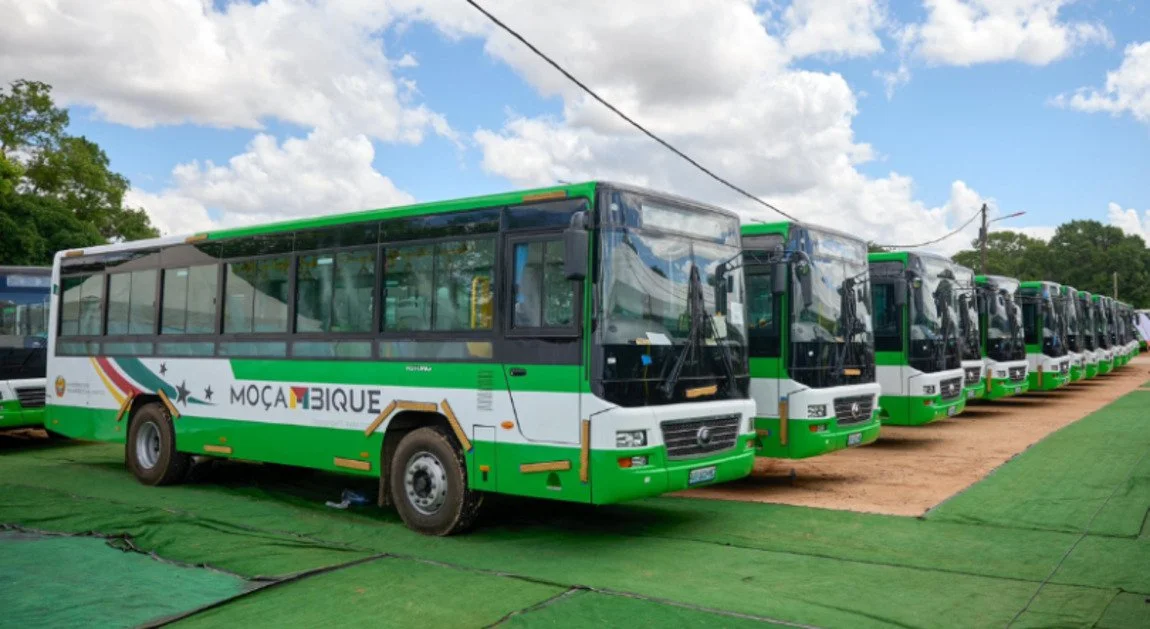
On 11 May 2026, President Daniel Chapo ordered 190 newly delivered gas-powered buses into immediate operation in the Maputo Metropolitan Area, framing the deployment as both a transport intervention and an energy-sovereignty statement at a time of fuel-price pressure and supply strain. Mozambique’s Presidency said the buses were delivered in Matola to reinforce public passenger and school transport, with 150 allocated to Maputo metropolitan municipalities and 40 dedicated to school transport, while Club of Mozambique, citing Lusa, reported that another 10 identical buses went to Inhambane.
The move gives Mozambique’s gas ambitions a domestic face. For years, the country’s natural-gas narrative has been dominated by export-scale liquefied natural gas (LNG), from Eni’s Coral South floating LNG unit to TotalEnergies’ Mozambique LNG restart and Eni’s sanctioned Coral North development. But Chapo’s bus rollout points to a second, politically sharper question: whether Mozambique can convert its gas endowment into lower mobility costs, local industrial activity and visible relief for households before the full export prize is realised.
The policy logic is not new. A 2010 International Energy Agency working paper published through the OECD argued that natural gas vehicle programmes can offer context-specific benefits where governments are seeking to improve urban air quality, replace imported petroleum products with domestic gas, reduce subsidy pressure, support gas-market development and strengthen energy security. For Mozambique, that reads less like distant transport theory than a live policy script.
A transport lede in an LNG country
The Chapo administration presented the bus deployment as a response to an international energy-price shock and its domestic consequences. The Presidency said the initiative came against “strong economic and energy instability” affecting fuel and transport prices, and quoted Chapo as saying that rising fuel, transport and essential-goods prices were “not an isolated phenomenon of Mozambique” but a global reality.
That is the immediate policy theatre. Mozambique has been wrestling with fuel scarcity and price pressure at the pump, while vehicle natural gas has attracted renewed attention because of its lower operating cost for some transport operators. Lusa, cited by Club of Mozambique, reported that Mozambique’s fuel crisis was driving demand for vehicle natural gas and conversion requests, with Autogás executive director João das Neves saying operating costs could be cut by about 50%, although conversion capacity remained limited.
The economics explain the renewed interest. According to the same report, natural gas rose from 41.11 meticais to 52.73 meticais per equivalent litre from 7 May, still far below the reported diesel and petrol prices of 93.69 meticais and 116.25 meticais, respectively, after sharp increases. Mozambique had installed capacity to supply about 10,000 gas vehicles, but just over 4,000 were effectively using natural gas, mainly in Maputo, while around 80 buses had already been converted and another 190 were being prepared to enter service.
The OECD/IEA study explains why such a pricing gap matters, but also why it is not sufficient on its own. It found that natural gas can compete with gasoline where gas transmission and distribution grids are present, but that countries may still need investment in vehicles, retail infrastructure and gas networks before natural gas vehicle markets become self-sustaining. In Mozambique’s case, the fuel advantage is visible at the pump; the harder test is whether infrastructure can spread beyond a southern corridor into a national system.
The national programme now has a launchpad
The buses are not a standalone procurement story. Chapo used the handover to announce that Mozambique would launch a National Vehicle Gas Massification Programme this year, with the launch expected in Inhambane, a province already central to Mozambique’s long-running gas exports to South Africa. Club of Mozambique, citing Lusa, reported Chapo as saying the country would move to launch the programme in Inhambane, where Mozambique has exported gas to South Africa for more than 20 years.
That chronology matters. Mozambique’s vehicle-gas strategy did not begin with the 2026 bus handover. In May 2022, Sasol announced a US$5 million natural-gas vehicle fund with Banco Nacional de Investimento and the Ministry of Mineral Resources and Energy to support conversions, refuelling infrastructure and related compressed natural gas (CNG) projects, especially in public transport fleets. Four years later, the new bus deployment appears to move the policy from financing architecture into visible fleet deployment.
The OECD/IEA paper gives the Chapo government’s approach a wider frame. It notes that natural gas vehicle programmes are often driven less by greenhouse-gas reduction alone than by practical national objectives: easing pressure on oil imports, improving security of supply, supporting gas-market development and reducing government exposure to fuel subsidies. That is precisely the language now emerging from Maputo, where the Presidency linked the buses to the “valorisation” of national energy resources and reduced cost of living. In Chapo’s compressed political line, “O gás é moçambicano” — the gas is Mozambican.
There is also an urban-health argument, though it should be made carefully. The OECD/IEA study says natural gas vehicles can improve local air quality, particularly in non-OECD countries where vehicle standards may lag those in advanced markets and diesel pollution remains a larger urban problem. It also notes that CNG buses can perform strongly on particulate matter and nitrogen oxides in some technical comparisons, while methane and hydrocarbon emissions still require attention. For Maputo, the strongest near-term case is therefore not that gas buses are a complete decarbonisation answer, but that they may offer a pragmatic bridge: cheaper fuel, lower exposure to imported petroleum products and potential local air-quality gains if deployed and maintained properly.
Coral South gave Mozambique its LNG proof point
The domestic-gas push is unfolding alongside the country’s larger LNG buildout.
Eni’s Coral South project remains the foundational proof point. Eni says Coral South develops gas from Mozambique’s offshore fields by liquefying it through the Coral Sul FLNG unit, allowing LNG to be shipped to global markets. The company describes Coral South as the first Area 4 project approved by Rovuma Basin partners for the development of offshore gas resources, focused on the southern part of the Coral field with around 500 billion cubic metres of gas resources.
Coral South also marked Mozambique’s operational entry into LNG exports. Eni says the first cargo of LNG produced from the Coral South field departed from the FLNG plant in November 2022, making Mozambique an energy-producing country with the capacity to contribute to security of supply.
That export milestone now sits in contrast with the new domestic transport push. Coral South proved Mozambique could produce LNG offshore. The gas-bus rollout tests whether the same resource story can be made legible to commuters, transport operators and households facing rising costs.
Coral North locks in the second offshore wave
The next major step is Coral North. Eni says Coral North will duplicate and complement Coral South by developing gas from Mozambique’s offshore fields, converting it into LNG and distributing it globally by ship. The project is under development and, once operational, is expected by Eni to consolidate Mozambique’s role as an energy-producing country.
The resource base is material. Eni says Coral North will develop the northern section of the Coral field and is underpinned by estimated gas in place of more than 500 billion cubic metres. Its technological core will be another FLNG unit, designed as an enhanced replica of Coral South and incorporating lessons from the first project.
The chronology also matters. Eni’s Coral North project page shows the environmental process moving through 2023 and 2024, with the Environmental Licence issued in December 2024, followed by a final investment decision in October 2025 and a hull launch milestone announced in January 2026. This is the export-side mirror of Mozambique’s domestic transport push: while Maputo deploys gas buses, the Rovuma Basin is being prepared for a second floating LNG wave.
A possible third FLNG raises the stakes
The export story may not stop at Coral North. Eni has also signalled a possible third Mozambique FLNG in its 2026 Capital Markets Update, placing a “3rd FLNG Mozambique” beyond 2030 in a slide on future FLNG deployment. That should be treated as a prospective development, not a sanctioned project.
The distinction matters. A third FLNG is not yet a final investment decision, and it should not be reported as one. But its appearance in Eni’s forward portfolio is significant because it suggests Eni sees Mozambique not merely as a one-project LNG jurisdiction but as a repeatable floating-LNG platform, with Coral South providing the operating template and Coral North providing the scale-up model.
The policy implication is sharper when set beside the OECD/IEA’s framework. Natural gas vehicles can be a domestic demand anchor only if they are supported by infrastructure, durable pricing policy and coordinated public-private execution. The paper warns that temporary government support may be required to establish a market, but also that tax and subsidy policies must be sustainable over the long run. Mozambique’s offshore gas expansion may give the country the resource base; it does not by itself build refuelling stations, conversion workshops or a bankable transport-fuel market.
Area 1 restart brings the other half of the LNG map back into motion
On the Area 1 side, TotalEnergies has also moved the Mozambique LNG project back into active execution. On 29 January 2026, TotalEnergies announced the full restart of Mozambique LNG activities onshore and offshore, following the consortium’s 7 November 2025 decision to lift the force majeure declared in 2021.
TotalEnergies said construction activities had restarted at the Afungi site, with more than 4,000 workers mobilised, including more than 3,000 Mozambican nationals. It placed first LNG in 2029 and said the project was about 40% complete, with almost all engineering and procurement for main equipment executed during the force majeure period.
The financing track has also been reset. In December 2025, TotalEnergies said Mozambique LNG had concluded US$15.4 billion project financing in 2020 with about 30 lenders, and that after the force majeure period, partners agreed to provide additional equity to replace the UK Export Finance and Atradius contributions, representing about 10% of external financing.
The domestic bargain
This is the heart of the story: Mozambique is trying to run two gas strategies at once.
The first is the high-capital export strategy, built around Coral South, Coral North, Mozambique LNG and future Rovuma Basin options. It is aimed at global energy markets, foreign exchange, fiscal receipts, local content and the long-term industrial base.
The second is the domestic-use strategy, now made visible through gas-powered buses, vehicle conversions, prospective refuelling expansion and a promised National Vehicle Gas Massification Programme. It is aimed at the cost of movement, urban transport continuity and energy sovereignty in a country exposed to imported-fuel shocks.
The OECD/IEA paper helps define the bargain. Natural gas vehicles can be relatively affordable compared with other alternative-fuel vehicles, and the technology for vehicles and refuelling stations is already available. But the same paper cautions that natural gas vehicles remain a niche globally and that the market has historically been concentrated in a limited number of countries rather than spread evenly across transport systems. The implication is clear: Mozambique’s bus programme can be strategically useful without being transformational overnight.
The policy challenge is that the domestic strategy cannot simply ride on the prestige of the export strategy. Vehicle natural gas requires refuelling stations, conversion capacity, finance, standards, maintenance systems and predictable pricing. The current system remains heavily concentrated in the south, with Club of Mozambique reporting that Autogás had eight filling stations, all in the southern zone, and plans for gradual expansion into Gaza and Inhambane.
The environmental case is also bounded. The OECD/IEA study says an average 25% reduction in carbon dioxide-equivalent emissions can be expected on a well-to-wheel basis when CNG light-duty vehicles replace gasoline vehicles, while the potential to displace large quantities of diesel in heavy-duty vehicles remains underutilised. For Mozambique, that means gas buses may be a credible transition tool, not a final climate destination.
That infrastructure gap is where Mozambique’s gas-to-transport experiment will either become a serious domestic-energy pathway or remain a Maputo-centred pressure valve during fuel crises. The bus rollout gives the government an immediate political win. The massification programme will decide whether it becomes a national model.
For now, the chronology is clear. Mozambique’s vehicle-gas financing lane was being formalised by 2022, Coral South proved offshore LNG production and exports, Mozambique LNG restarted after years under force majeure, Coral North reached final investment decision and moved into its next execution phase, Eni has signalled further floating LNG options beyond 2030, and in May 2026 Mozambique put gas-powered buses on the road.
That is a consequential shift. Mozambique’s gas future will still be measured in tonnes per annum, billion-dollar financing packages and offshore project milestones. But increasingly, it will also be judged at bus stop
