PE Energy’s ANOH Milestone Puts Nigeria’s Gas Build-Out Back in Focus as Deepwater Drilling Queue Builds
PE Energy’s completion of its safety-critical scope on the ANOH Gas Project marks a quiet but consequential step in Nigeria’s gas build-out, as the country tries to convert vast reserves into dependable fuel for power, industry and growth. With ANOH moving through early operations and offshore players including Chevron and Eni lining up fresh drilling and development activity, Nigeria’s energy sector is entering a new test: whether renewed project momentum can translate into reliable gas supply, sustained upstream investment and infrastructure that actually performs.
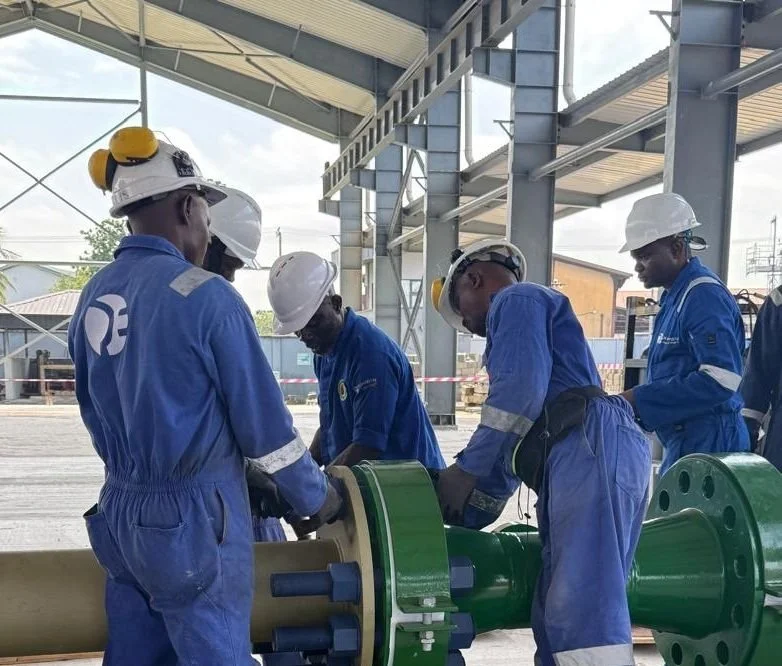
Imo State, Nigeria | May 25, 2026 - PE Energy has completed its assigned scope on the Assa North–Ohaji South gas project, adding a technical but strategically significant marker to Nigeria’s long-running effort to turn stranded and associated gas into domestic power, industrial fuel and export-linked feedstock.
The company said it delivered a High Integrity Pressure Protection System for the ANOH Gas Project, a safety-critical system designed to support rapid shut-in protection under high-pressure operating conditions. The work was executed for Renaissance Africa Energy Company of Nigeria Limited and tied to a gas development designed to process 300 million standard cubic feet per day, according to PE Energy’s project update.
The milestone lands at a telling moment. In Nigeria’s gas patch, ANOH has moved into early operations after first gas in January 2026, though its full 300 MMscfd ramp-up still depends on offtake and evacuation progress. Offshore, Chevron and Eni are separately pushing ahead with drilling, appraisal and procurement steps that suggest Nigeria’s upstream sector is beginning to draw new capital attention after years of delayed projects, regulatory uncertainty and underinvestment.
A Safety System for a Strategic Gas Asset
ANOH is not merely another plant in Nigeria’s project register. It sits at the intersection of three national priorities: monetising gas, reducing routine flaring and supplying cleaner fuel into a power system long constrained by weak feedstock reliability.
The field itself is a unitised development of Assa North in OML 21 and Ohaji South in OML 53. AGPC describes the project as a greenfield gas development aimed at supporting Nigeria’s domestic market, with wet gas from the ANOH field processed into dry gas, liquefied petroleum gas and condensate. The plant is located in Imo State, close to Owerri and about 70 kilometres north-west of Port Harcourt.
That architecture matters. ANOH’s upstream resource is split across legacy and newer operating structures. On the OML 53 side, Seplat Energy says deeper reservoirs in the Ohaji South field are being developed with Renaissance Africa Energy under a unitised development with Assa North in OML 21. Seplat says the project achieved first gas in January 2026 after completion of the 11-kilometre Indorama export pipeline
PE Energy’s completed scope fits into that operating chain at the point where gas infrastructure must move from construction narrative to disciplined reliability. A High Integrity Pressure Protection System is not the most visible part of a gas plant, but it is one of the systems that determines whether a high-pressure asset can operate safely and consistently. For a plant expected to anchor domestic gas supply, the significance is less ceremonial than functional: Nigeria does not just need gas reserves; it needs infrastructure that can run.
From Legacy SPDC to Renaissance
The Renaissance link gives the ANOH update a wider corporate context. Renaissance Africa Energy Company says it emerged on March 13, 2025 following the acquisition of Shell’s shareholding in SPDC by Renaissance Africa Energy Holding Limited. The company says the holding entity is owned by ND Western, Aradel Energy, Waltersmith, First E&P and Petrolin Trading, and that Renaissance now operates the joint venture comprising NNPC, Renaissance, TotalEnergies and AENR.
That transition is important for Nigeria’s onshore and swamp upstream landscape. Assets once identified primarily with international oil company operatorship are now increasingly being managed through domestic-led structures, even as technical, safety and execution standards remain central to bankability. ANOH therefore serves as both a gas supply project and an early test of post-divestment operating credibility.
The project has already begun to show early volumes. Seplat says wet gas production stabilised at 40 to 52 MMscfd from four upstream wells, with condensate output of 2.0 to 2.5 kboepd, while volumes are expected to rise as the plant ramps up toward its full 300 MMscfd capacity. That ramp-up, however, is tied to evacuation and offtake progress, including new gas sales agreements and the future completion of the OB3 pipeline.
ANOH’s Long Road to First Gas
The chronology is part of the story. ANOH was conceived as one of Nigeria’s strategic gas infrastructure projects, but like many large Nigerian energy developments, its progress has been shaped by the familiar realities of pipelines, regulatory approvals, field readiness and market offtake.
AGPC’s own description places the project in the midstream, with wet gas from the ANOH field processed and transported through the OB3 pipeline. The plant is expected to produce dry gas, liquefied petroleum gas and condensate, supporting a shift from small-scale diesel generation toward natural gas for power generation.
Seplat’s January 2026 first-gas update showed that the project had begun to move despite OB3-linked constraints. The initial route to Indorama created a working outlet for supply, while the broader domestic-gas promise remains linked to eventual expansion of evacuation routes. In that light, PE Energy’s completed safety scope is less an isolated contractor announcement than a sign that the plant’s operating envelope is being progressively hardened as volumes build.
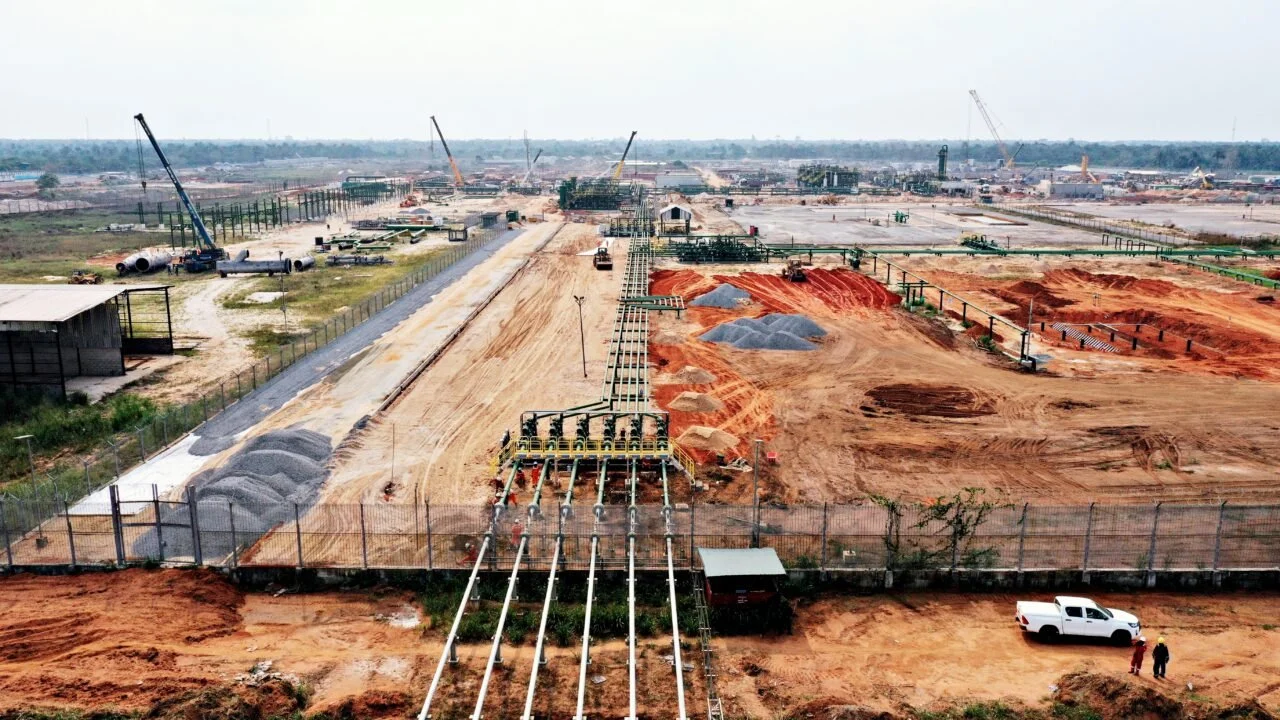
Photo Credit: Anoh Gas
Offshore Confidence Returns to the Frame
The ANOH update is also arriving alongside a distinct but related trend offshore. Chevron is preparing for a drilling campaign tied to Agbami and Ikija, while Eni is pushing forward Zabazaba-Etan, one of Nigeria’s most closely watched deepwater developments.
Meren Energy reported that activity on PML 52, covering Agbami, and PPL 2003, covering Ikija, has focused on progressing the first phase of an upcoming drilling programme scheduled to begin in the fourth quarter of 2026, starting with the Ikija appraisal well. The company said the broader Agbami infill drilling programme remains on track, with six infill wells planned across 2027 and 2028.
That update follows Chevron’s earlier indication that it planned to bring a rig into Nigeria in late 2026 to drill a newly discovered resource near Agbami and extend leases on existing assets. Reuters reported in December 2025 that Chevron also planned to participate in Nigeria’s next oil licensing round, with the company citing improved regulatory clarity under the Petroleum Industry Act.
For Nigeria, the offshore signal is important because deepwater projects provide the scale required to arrest production decline. Infill drilling at a mature giant such as Agbami is not the same as a frontier discovery, but it is often the kind of lower-risk barrel that can be sanctioned when fiscal and operating terms improve. Nigerian Upstream Petroleum Regulatory Commission production data show Agbami condensate output averaged roughly 71,400 barrels per day in 2025, underscoring the continuing relevance of brownfield work at one of Nigeria’s major offshore assets.
Eni’s Zabazaba-Etan Push
Eni’s Zabazaba-Etan project adds another layer to the emerging investment picture. In March 2026, Eni said its meeting with President Bola Tinubu included discussion of the conversion of OPL 245 into two petroleum mining leases, PML 102 and PML 103, and two petroleum prospecting licences, PPL 2011 and PPL 2012. The company said the project agreements would enable development of the Zabazaba and Etan fields.
The scale is material. Eni says the Etan-Zabazaba development is built around approximately 500 million barrels of reserves, a 150,000-barrel-per-day floating production, storage and offloading vessel and peak gas exports of 200 MMscfd through Nigeria LNG. (eni.com)
Procurement activity has begun to surface publicly, although the prequalification notice should not be read as a final investment decision or contract award. Nigerian Agip Exploration issued a prequalification notice for engineering, procurement and construction services for the subsea production system and aftermarket services for the Zabazaba and Etan development project, with the tender notice dated May 14, 2026.
That does not by itself guarantee final investment momentum, but it does indicate that the project is moving beyond diplomatic reset and licence conversion into execution planning. For a development long associated with OPL 245 disputes, that shift is notable.
Gas, Oil and the New Nigerian Test
Taken together, the developments point to a more complicated but more consequential phase for Nigeria’s energy sector. Onshore and nearshore gas infrastructure is being asked to deliver power-sector reliability and industrial fuel. Offshore deepwater assets are being asked to restore investor confidence and add barrels. Indigenous and domestic-led operators are taking greater responsibility for legacy assets, while international companies are still needed for capital, technology and deepwater execution.
ANOH sits at the centre of that balancing act. Its 300 MMscfd design capacity is significant in a country where power generation, industrial output and household energy access remain constrained by infrastructure bottlenecks rather than resource scarcity. But the project’s early operating reality also underscores the old Nigerian lesson: reserves do not become revenue, and plants do not become national supply, until pipelines, offtake, safety systems and commercial arrangements work in sequence.
PE Energy’s completed scope is therefore a small window into a larger story. Nigeria’s gas future will not be built by policy declarations alone. It will be built through systems that hold pressure, wells that sustain feedstock, pipelines that move volumes and contracts that turn gas into cash flow. ANOH has now moved further along that chain. The harder test is whether Nigeria can make that progress routine.
